Software

The Standard is software neutral.

It still has a reference implementation. Conformance is defined by the published weights, the locked scores and the per-element scoresheet a host releases, never by the product used to produce them: a clipboard and a calculator conform if they preserve all three.

What conformance asks of a tool

The Council names LiveJudgeâ„¢ as a reference implementation, and these are the four behaviors that naming rests on. Each one maps to a condition a host has to keep either way. Michael Kranitz, who founded the Council, has a financial interest in LiveJudge, and that is disclosed here and in the Charter.

Reference implementation

What enforcement looks like when it is built in

The Council does not require any particular software, and any platform that preserves the published weights, locks scores before discussion and produces a per-element scoresheet conforms. The Standard is administrable on paper by design and the Council will adopt no change that makes that untrue. LiveJudge is the platform the Standard was written against, and it is the working example of what each condition looks like when the tool keeps it rather than the promoter's memory on show day.

a

The division tables are there before you start

Every division, weight and element in the Standard ships preloaded. A host can change any of it, but a new show starts as the published instrument rather than an empty grid somebody fills in the week before.

Supports Publish before you open
b

The score says what it means, in words

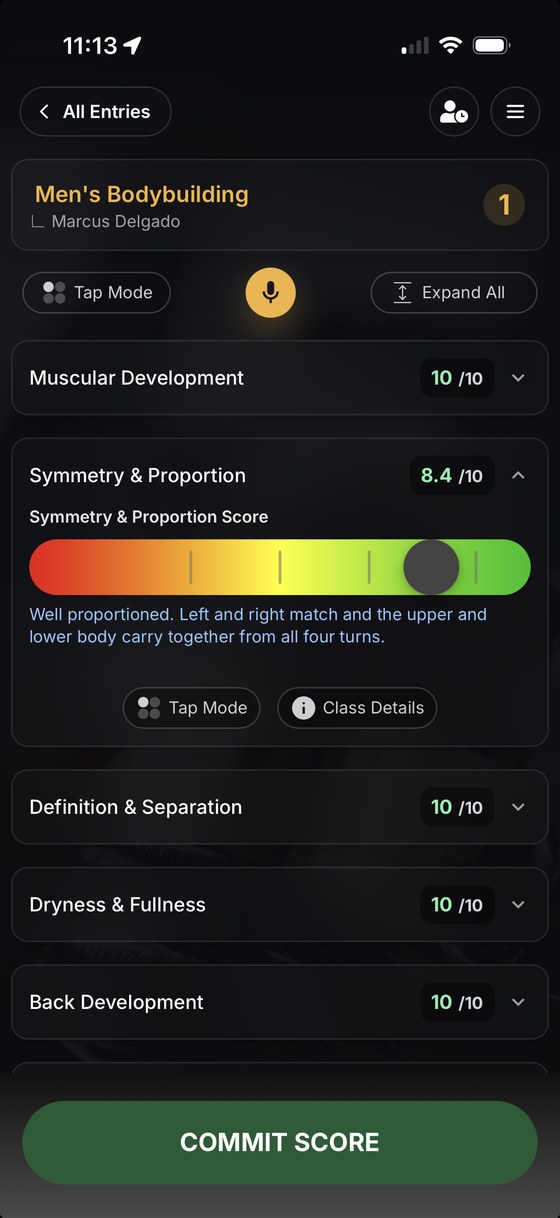
Each element is a 0 to 10 slider, and as the judge moves it the band wording for that value is displayed. A 7.5 is not a number a judge has to interpret privately: it reads back the published wording for a 7.5, so two judges land on the same number for the same reason.

Supports Score the rubric as published
c

Scores lock, and the arithmetic is not negotiable

A judge submits on their own phone, and a submitted score is not editable by a judge, a head judge or a promoter. The high and the low are dropped and each judge's spread is normalized by formula. A panel that wanted to agree a placing first would have to do it where the record shows they did.

Supports Judge independently
d

Per-athlete scoresheets, with the caps on them

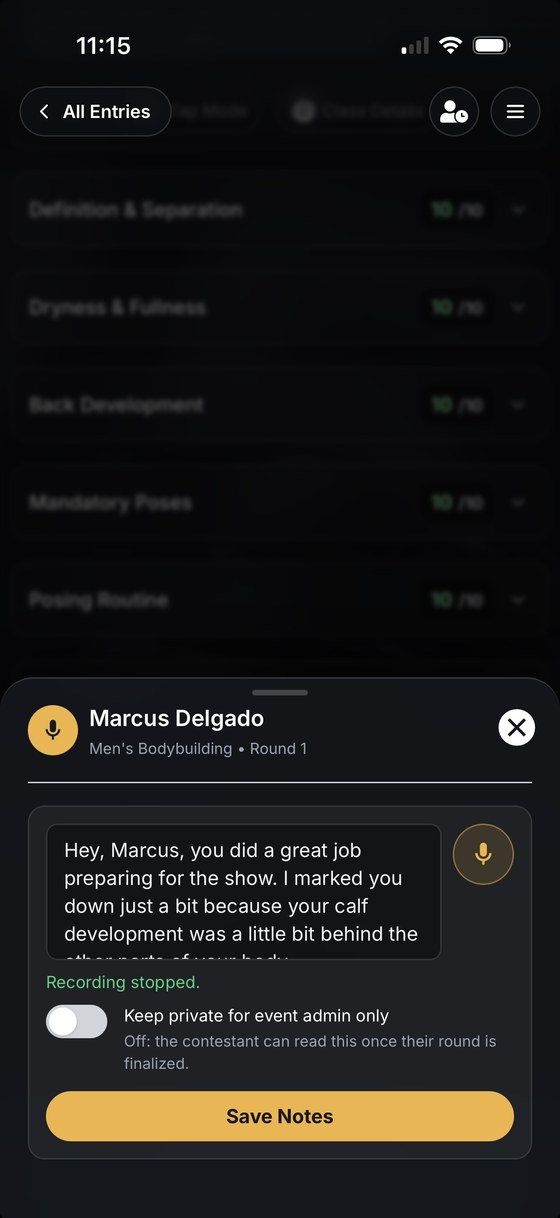
The host prints or sends a scoresheet for every athlete: elements, weights, the score on each, any health cap and the condition that triggered it, and the total. Judges dictate a note instead of typing it, which is the only way a note survives the turnaround between callouts, and the note goes out with the sheet.

Supports Release and explain

Every one of those four is a condition of the claim in the Standard's Conformance section, whether the tool keeps it or a person does.

The Standard, as the software ships it

Screens from a real event built on the published instrument, not a mockup. The division tables and the band wording below were loaded from the Council's preset, not typed in by hand, which is the point: a host starts from the Standard rather than from an empty grid.
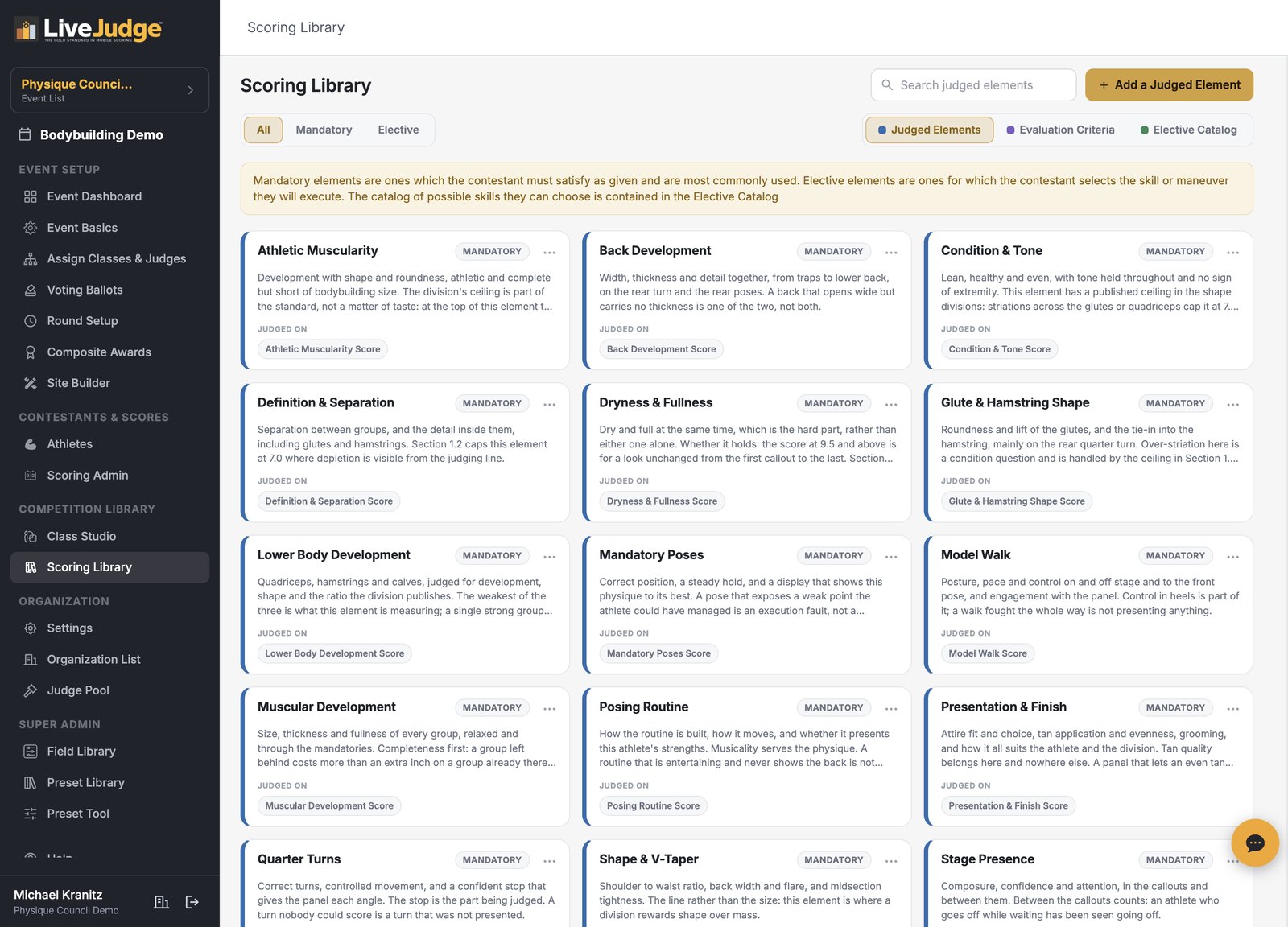
The scoring library showing the sixteen judged elements of the Physique Standard
All sixteen judged elements, preloaded. Each carries the Council's own description and the single criterion it is scored on. The health caps are in the element text: Definition & Separation names the 7.0 cap for visible depletion, and Condition & Tone names the shape-division ceiling.
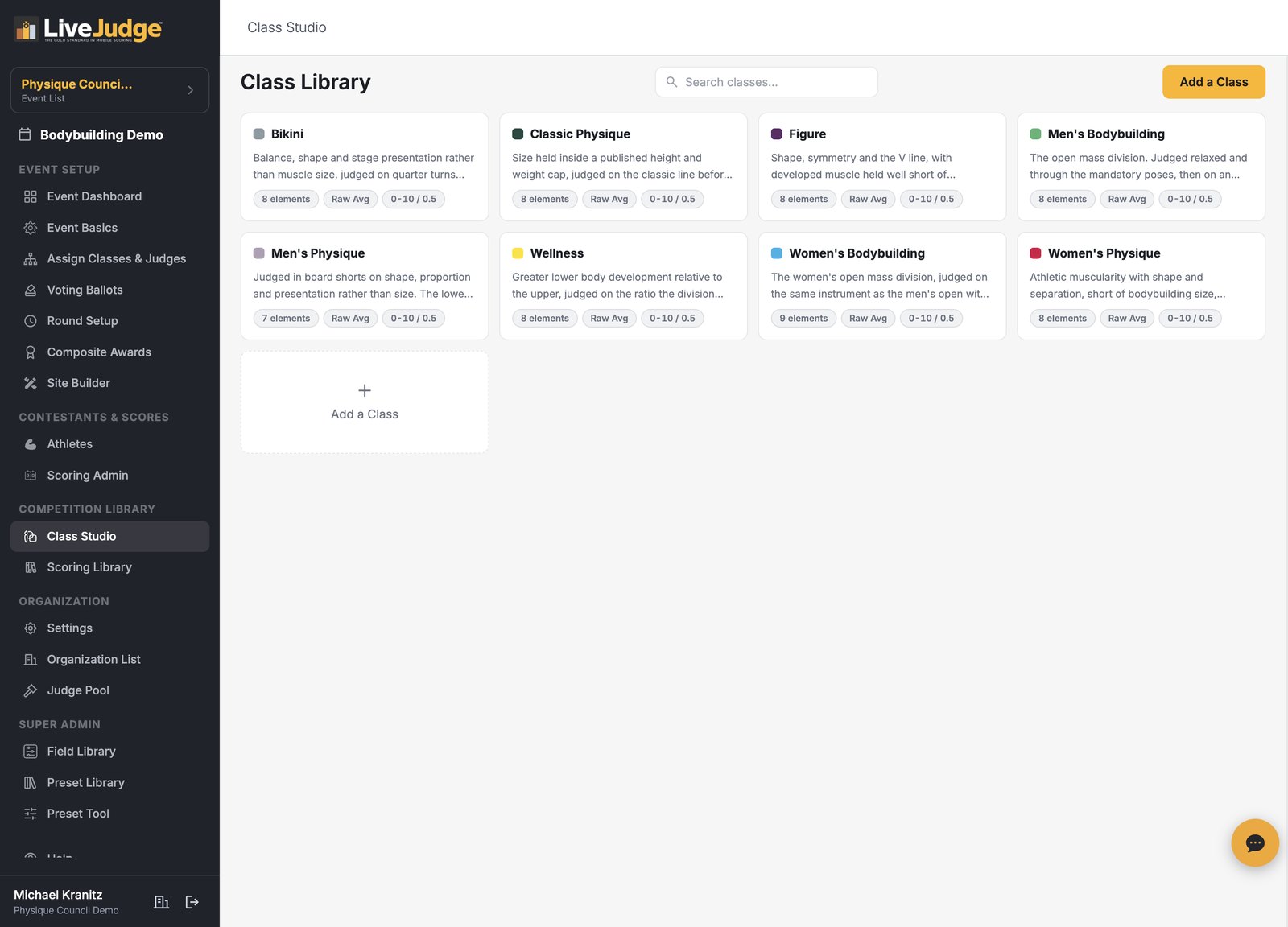
The class library showing the eight published divisions and their element counts
Eight divisions, each with its own table. The element counts match Section 2.2 exactly: seven for Men's Physique, nine for Women's Bodybuilding, eight for the rest. No division carries all sixteen.
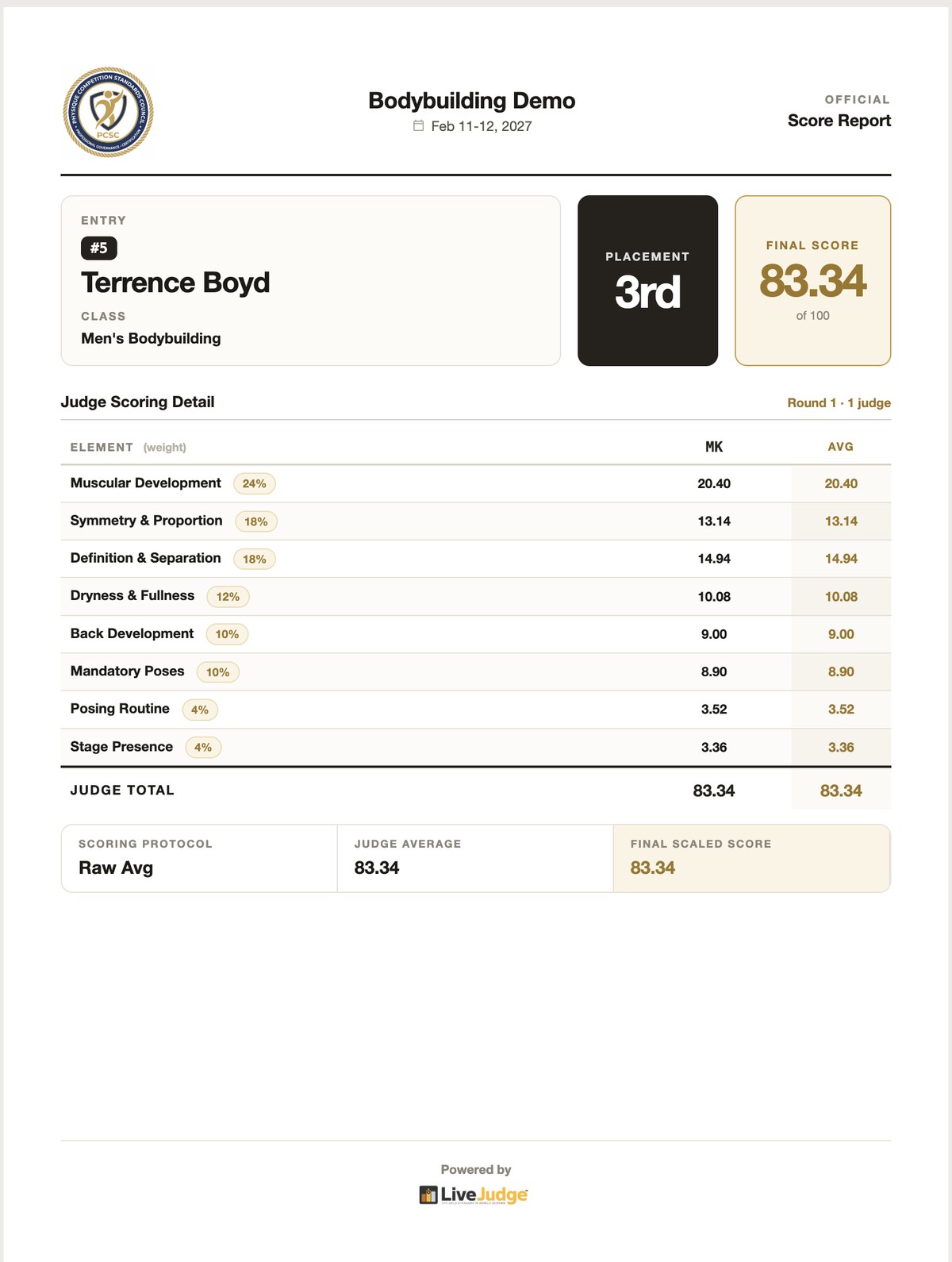
An official score report for one athlete, showing every element, its weight and the points it contributed
The scoresheet Section 1.3 requires. Placement, final score, then every element, the weight it carried and the points it contributed. The weights are the published Men's Bodybuilding table, 24 down to 4, summing to 100. This is what an athlete leaves with instead of a placing and a shrug.
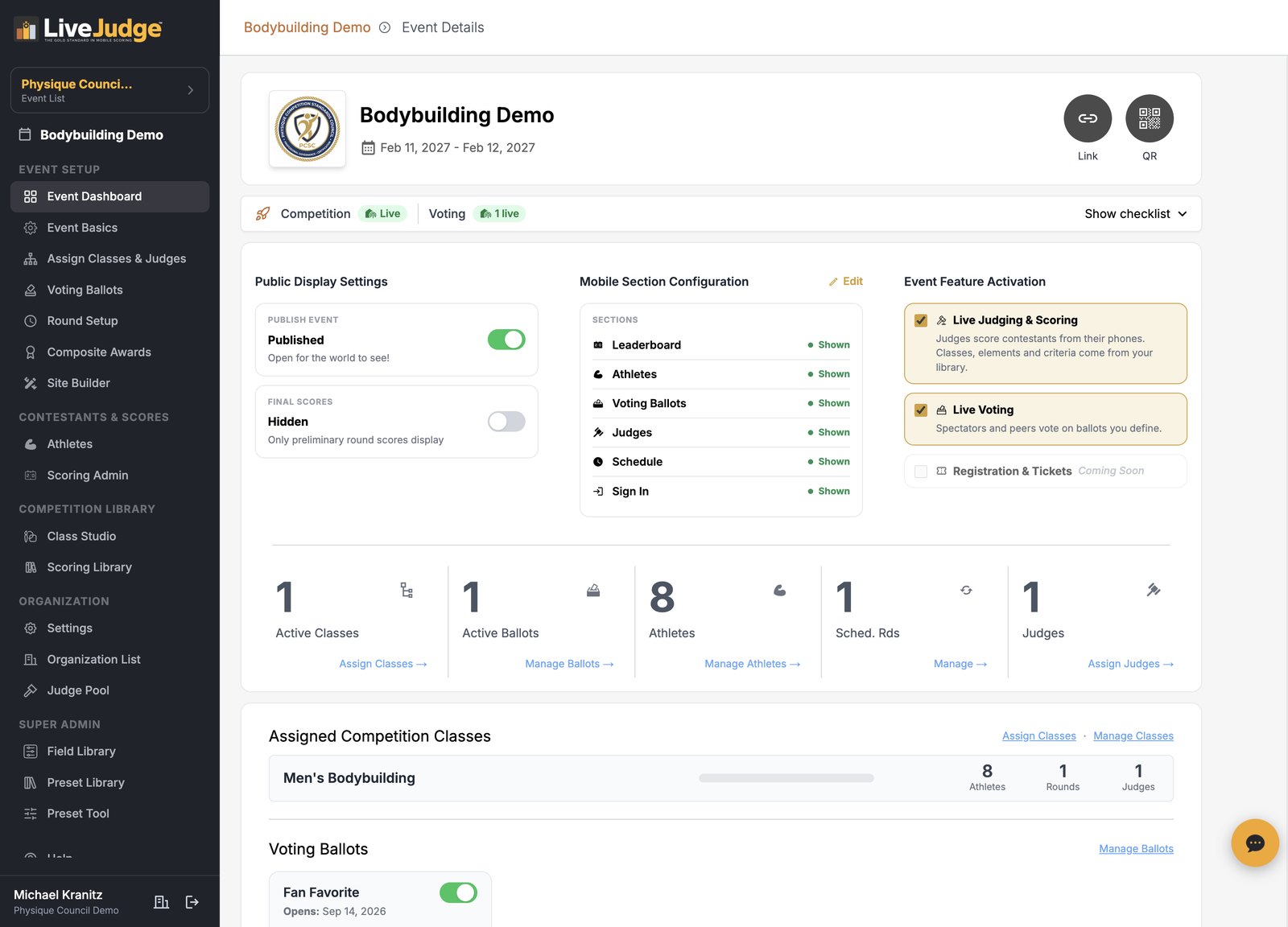
The organizer console for a physique show
Run the show from one console. Classes, ballots, athletes, rounds and judges, with publishing controlled from a single checklist.
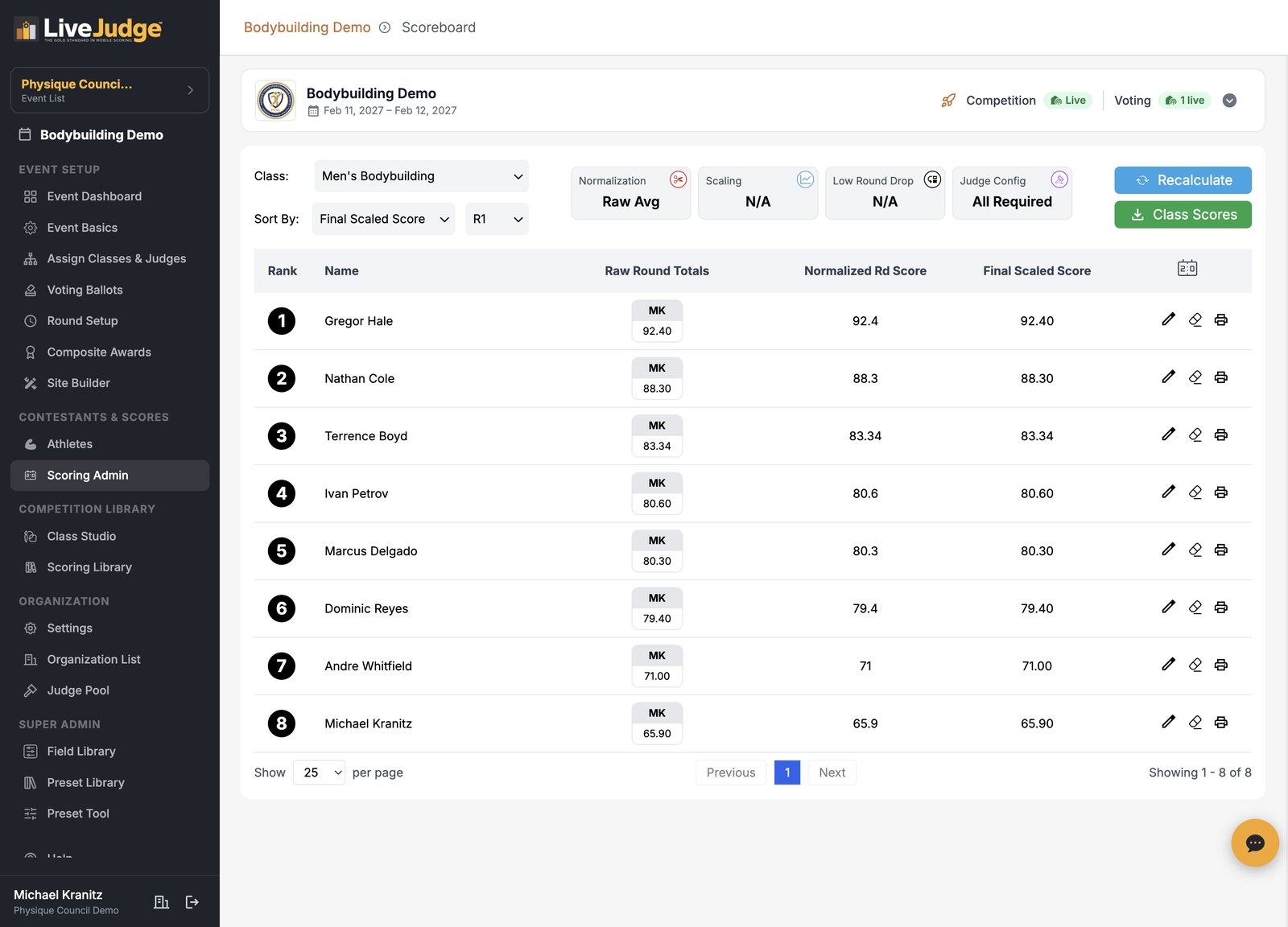
The scoring console showing normalization, scaling, low round drop and judge configuration
The arithmetic of Section 1.1, in the open. The class ranked by total, with normalization, scaling, low round drop and judge configuration shown as settings on the class. Published with the result rather than decided afterward.

On the day

The same show, from four sides.

What the four conditions look like backstage: what an athlete sees, what a judge is handed, what the audience gets, and what the promoter runs it all from.

The athlete

Signs in by scanning the show's QR code. No password, no download. Sees their division, the table it will be judged on, and the band wording behind every element, before they step on stage.

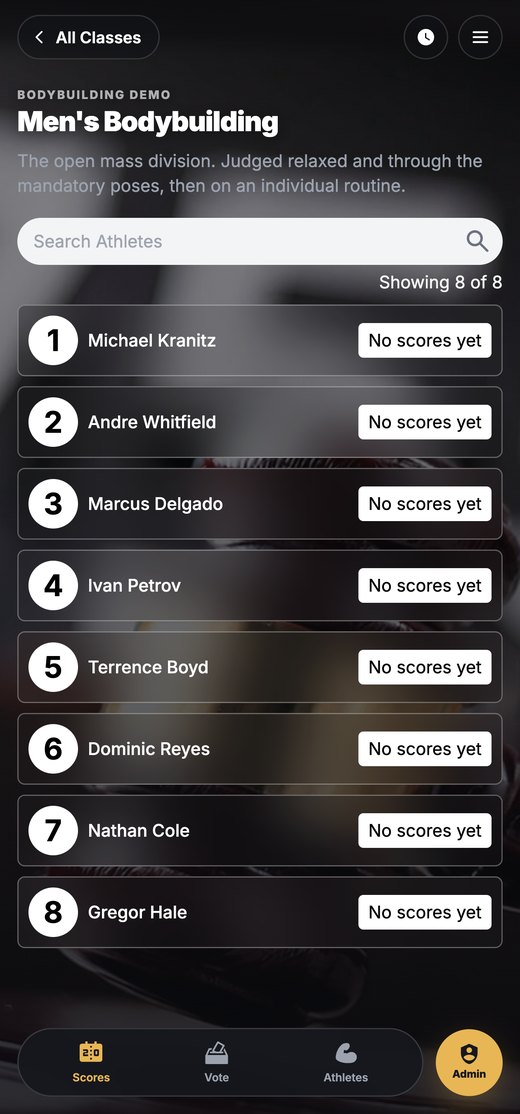
The class on a phone, showing every athlete in the division

The judge

Scores on their own phone against the published weights. Moving the slider prints the band wording for that value, so a 7.5 is not left to private interpretation. The score locks when it is submitted, before any comparison is discussed. A note is dictated rather than typed, which is the only way one survives the turnaround between callouts, and the judge chooses whether the athlete sees it.

A judge scoring an element, with the band wording printed under the slider
A judge dictating a note for an athlete, with the private or visible toggle

The audience

Scans the same code to browse the class from any seat, and votes for a People's Choice award. Audience voting is reported separately and never touches a judged placing.

Every screen above is from a live event running the published instrument. Everything about the platform lives at livejudge.com.